Please ensure Javascript is enabled for purposes of website accessibility Understanding When to Repair, Restore, or Replace Your Commercial Roof Call Us Now
80 Years Combined Experience in Commercial Roofing Nationwide

Understanding When to Repair, Restore, or Replace Your Commercial Roof

Understanding When to Repair, Restore, or Replace Your Commercial Roof

Understanding When to Repair, Restore, or Replace Your Commercial Roof

Florida commercial property owners and condominium managers are faced with critical decisions when dealing with an aging or leaking roof.

Before committing to the major expense of installing a complete roof replacement, building owners and property managers must weigh their options – keep patching the existing roof for another temporary fix, or invest in a larger-scale solution with long-term benefits, like reroofing or restoration

When is it more cost-effective to restore your roof rather than continuously patching it up?

In situations where the roof is relatively new, the damage to a commercial roof is localized, and there are no widespread problems involving moisture leakage or compromised insulation, patching and repairing can be a practical and cost-effective solution. 

However, restoration or replacement becomes necessary if your commercial roof –

  • Is approaching the end of its expected lifespan – typically 15-30 years
  • Requires frequent repairs
  • Damage spreads to more than a quarter (25%) of the roof’s surface 
  • Structural weaknesses are apparent

Signs Your Commercial Roof Needs Attention – When is it time for a roof inspection?

  • If you notice water infiltration, it’s time for a roof inspection. Water stains on your ceilings or walls are usually a sign of roof leaks. 
  • Sagging or dipping in the roof surface indicates structural issues that need immediate attention.
  • Cracks or Curling in asphalt shingles are indicators of wear and tear. 
  • Blisters or bubbles on the roof surface can indicate trapped moisture or air under the roofing membrane, weakening the roof’s structural integrity.
  • Mold or mildew growth due to water damage
  • Moss or algae on the roof can indicate that it’s retaining moisture.

Damage from prolonged water accumulation is the primary culprit of structural degradation

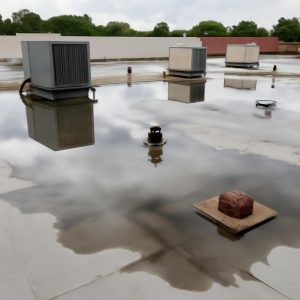
Ponding water on flat roofs is a frequent issue that can lead to long-term damage and serious complications if not properly managed.

roof ponding

What is Roof Ponding?

Roof ponding refers to the accumulation and stagnation of water on a roof surface for more than 48 hours following a rainfall event. 

While a little standing water on a flat roof for a short time after a rainstorm is considered normal, any water remaining for longer than two days is considered ponding.

Roof ponding can cause significant problems on flat or low-slope roofs, especially after heavy rains. Large puddles may develop on the roof if the drainage system is improperly installed, insufficient for the structure, or if there are other flaws in the roof design or building infrastructure.


Ponding can lead to leaks, weaken the roof’s structural integrity, and provide a breeding ground for algae and mold, which can further damage the roof surface. Concentrated sunlight on ponded water can cause UV damage – accelerating the deterioration of the roof membrane.


Over time, the accumulation of ponding water can lead to the gradual deterioration of the roof’s protective barrier. This prolonged exposure weakens the integrity of the surface, creating pathways for water to penetrate through. As the roof membrane becomes increasingly compromised, the damage exacerbates, which not only results in more significant structural issues but also drives up repair expenses considerably.


Only an onsite field inspection reveals the true condition of the existing rooftop

Before providing an estimate, reputable roofing contractors conduct an onsite field inspection to assess any damage, present a professional evaluation of the condition of your roof and help you consider your repair, restoration and replacement options.

  • Commercial roof inspections are best done twice a year, preferably in the spring and fall to evaluate and address any damage promptly and prepare the roof for the Atlantic hurricane season – June 1 – Nov 30.
  • Inspections are also recommended after significant weather events like hurricanes, tornados, or hailstorms.
  • Get a roof evaluation from a licensed roofing contractor or inspector. They are experts in identifying and diagnosing roof issues.

Navigating Between Re-roofing and Roof Replacement

A common dilemma for property owners is whether the existing roof must be completely replaced or whether re-roofing, also called overlaying or roof restoration is a viable option. 


Roof restoration involves installing an additional layer of roofing material directly on top of the existing roof rather than removing it entirely. This approach allows for the restoration of the rooftop without undergoing the more labor-intensive (and costly) task of tearing off and replacing the entire structure. Under Florida building codes, commercial properties are generally permitted two roof overlay applications before a full replacement becomes mandatory.


Roof restoration offers a significant cost advantage, typically saving property owners between $4 and $5 per square foot when compared to a complete tear-off and new installation. For many businesses, this financial incentive makes restoration an especially attractive option.


The good news is that a high percentage of commercial buildings qualify for overlay, often requiring only minimal repair and prep work beforehand. Most properties are excellent candidates for restoration using this method, allowing managers to avoid more substantial replacement investments. Determining if an overlay is appropriate for your building requires an evaluation from a qualified roofing professional who can assess structural conditions and ensure compliance with local regulations.

The Role of Silicone Roof Coatings

An increasingly popular and lesser-known option for roof restoration is the use of silicone roof coatings. This method is often a more viable solution than most property owners realize. Silicone coatings provide a durable, weather-resistant layer that effectively seals leaks and extends the life of an aging roof system. Many insurers even classify a silicone coating as maintenance rather than substantial structural overhaul. This classification can provide an additional incentive to opt for restoration instead of tearing off an old roofing system and installing a new one. 

In many cases, silicone coatings allow property owners to restore their rooftops at a fraction of the cost associated with full replacements, while still enjoying enhanced weatherproofing and energy efficiency. This option can be particularly advantageous in Florida’s climate, where roofs are frequently subjected to heavy rain, high humidity, and intense sunlight. 

Summary: Choosing the best approach to address an aging or leaking commercial roof requires careful consideration of the building’s condition and insurance implications. While patch repairs offer temporary relief, using modern materials like silicone coatings often provides a cost-conscious solution with long-term benefits. 

Cool Roof is a trusted partner – providing clients with roofing solutions and maintenance for decades to come.

Most new Cool Roof projects are referred by our satisfied clients.